
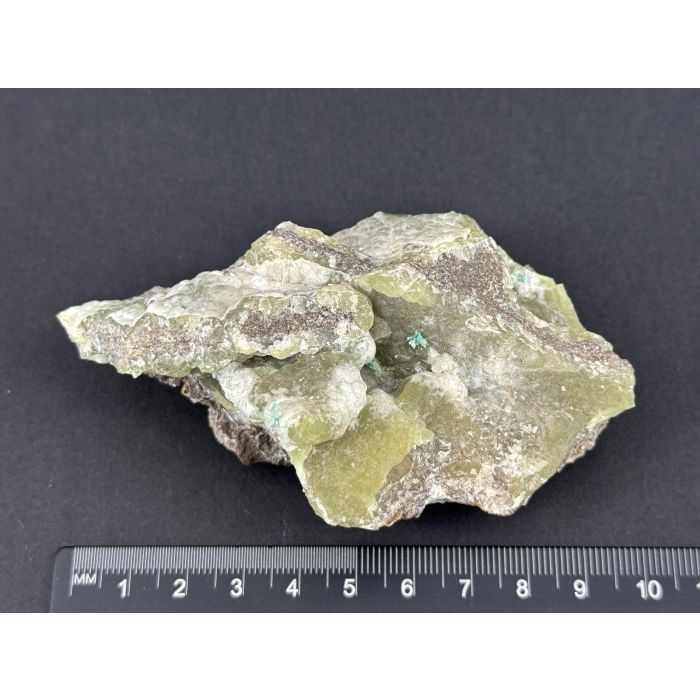
Smithsonite xls, Aurichalcite xls; 79 Mine, AZ, USA; Cab; unique piece
Smithsonite and Aurichalcite crystals from the 79 Mine, AZ, USA – cabinet specimen as unique piece
This attractive cabinet specimen from the famous 79 Mine features pale green to soft turquoise Smithsonite formations with associated Aurichalcite crystals. The surface is dominated by botryoidal, grape-like structures that give the specimen a highly three-dimensional and natural appearance. Fine blue-green Aurichalcite crystals are visible in several cavities and openings, creating an appealing color contrast with the Smithsonite. The combination of these two secondary minerals together with the attractive coloration makes this an excellent collector specimen from one of North America's most renowned zinc deposits.
Geology & Origin
Smithsonite is a zinc carbonate with the chemical formula ZnCO₃ and forms within the oxidation zones of zinc-rich ore deposits. Aurichalcite is a hydrated zinc copper carbonate hydroxide that commonly occurs together with Smithsonite, Hemimorphite and other secondary minerals. The 79 Mine near Hayden, Arizona, is a classic locality for colorful oxidation-zone minerals and is especially renowned for exceptional finds of Smithsonite, Hemimorphite, Aurichalcite and Wulfenite. The crystals and mineral coatings visible on this specimen provide an impressive example of the complex weathering processes responsible for the formation of this rare mineral assemblage.
This table is for general information and orientation, although the sizes of the stones may vary. In addition, this specification is handled differently from region to region.
| Sizes | Description | approx. Sizes in mm/cm | approx. Sizes in INCH | |
| Capsule | Capsule | 0.1–0.5 mm in a transparent hard capsule (approx. 1 cm) | capsule contents 0.1–0.5 mm | capsule contents 0.004–0.02 in |
| TN/mm | Micromount (TN = Thumbnail) | everything fitting in a TN Perky box or a MM box of approx. 1 in | approx. 0.5–2.5 cm | max. 1 in |
| Min | Miniature specimen | will not fit a TN or MM box anymore | approx. 2.5–5 cm | approx. 0.2–1.0 in |
| Scab | small cabinet specimen | approx. one-third to half a hand size | approx. 5–9 cm | approx. 1.0–2.0 in |
| Cab | cabinet specimen | full hand size | approx. 9–15 cm | approx. 2.0–3.5 in |
| large Cab | large cabinet specimen | approx. two hand sizes | approx. 15–30 cm | approx. 3.5–6.0 in |
| very large Cab | very large cabinet specimen | everything larger, no upper limit |
Abbreviations commonly used in mineralogy.
| Abbreviation | Meaning |
| xl | single crystal, possible with matrix |
| xls | noticeable crystals |
| (xl) | embedded or damaged |
| (xls) | embedded or damaged |
| MASS | massive and/or amorphous pieces |
| TYP | type locality of the original description |
| SWUV | shortwave-UV-reaction |
| UV | ultraviolet reaction |
| SC | self-collected |
| U | unique (single unique piece) |
Usage Instructions
This product is ideal as a collector's item, decorative element, teaching material, or for scientific and exhibition purposes.
Legal Notices
Safety
We accept no liability for damages resulting from improper and/or non-recommended use. Please carefully assess the suitability of the product before any alternative use.
Responsible Provider
Mikon Mineralienkontor GmbH
Steinslieth 11
D-37130 Gleichen OT Klein Lengden
Email: info@mikon-online.com
| shipment-weight, NOT netto weight (kg) | 0.500000 |
|---|