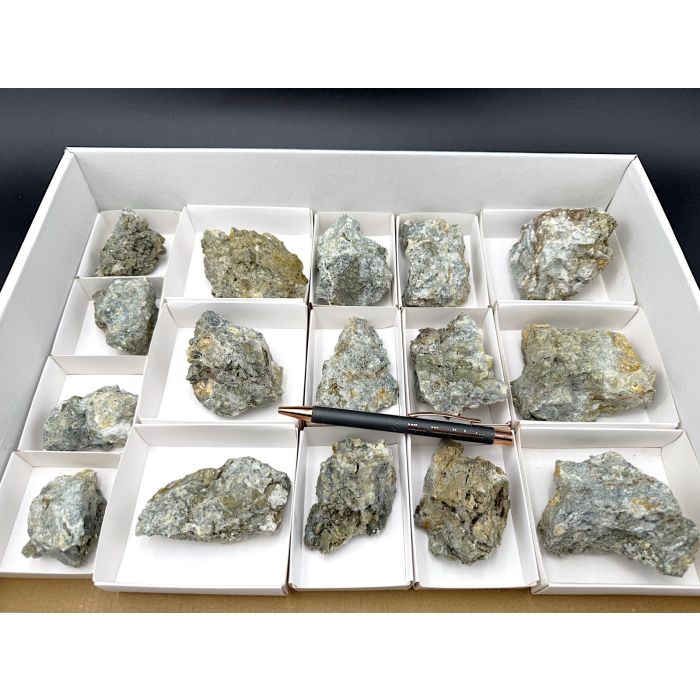
This flat with Scorodite crystals, partly with Schultenite crystals, from the Gold Hill Mine in Utah, USA represents a typical assemblage of arsenic bearing secondary minerals from this historic mining district. The specimens mainly consist of light gray to slightly greenish mineral aggregates with locally vitreous to dull luster.
Several pieces display fine Scorodite crystals occurring as small crystal aggregates or crystalline coatings on the surface of the matrix. In some specimens these occur together with Schultenite crystals, resulting in different mineralogical combinations within the flat. The collection documents several expressions of the mineralization from the Gold Hill Mine and provides a representative overview of typical material from this locality.
Geology & Origin
The Gold Hill Mine in Utah belongs to a historic mining area within the Tintic Mining District. The deposits formed when hydrothermal fluids deposited metal rich components in fractures and cavities of the host rocks. Subsequent weathering and oxidation processes produced numerous secondary minerals. Scorodite is a typical secondary arsenate mineral formed by the alteration of arsenic bearing primary minerals, while Schultenite is also a secondary oxidation mineral occurring within this mineral assemblage.