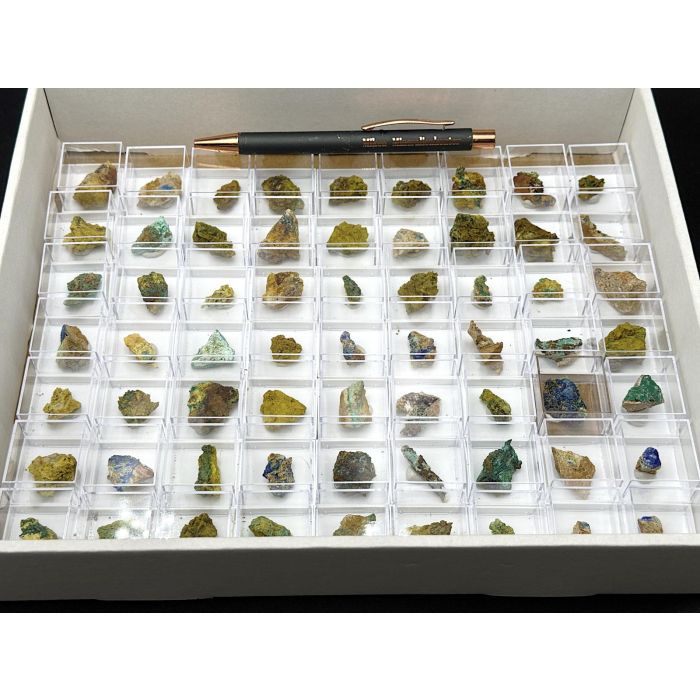
This half size flat presents a diverse selection of secondary arsenate minerals with Philipsbornite and Osarizawaite as characteristic components. The specimens predominantly display yellow, yellow green to olive colored coatings, partly accompanied by more intense green fine crystalline formations on matrix.
Crystals are clearly recognizable on many pieces. They typically occur as fine, dense crystal carpets, crusts, or small botryoidal aggregates, giving the specimens a vivid and highly textured surface. The interplay of different yellow and green tones, together with occasional associated secondary minerals, makes this collection particularly varied and attractive. The flat shown corresponds exactly to the offered collection.
as characteristic components. The specimens predominantly display yellow, yellow green to olive colored coatings, partly accompanied by more intense green fine crystalline formations on matrix.
Crystals are clearly recognizable on many pieces. They typically occur as fine, dense crystal carpets, crusts, or small botryoidal aggregates, giving the specimens a vivid and highly textured surface. The interplay of different yellow and green tones, together with occasional associated secondary minerals, makes this collection particularly varied and attractive. The flat shown corresponds exactly to the offered collection.
Geology & Origin
The Grandview Mine is a classic locality for rare secondary copper minerals formed in the oxidation zone of copper rich ore veins. Philipsbornite and Osarizawaite develop here as arsenates under oxidizing conditions and are commonly found in close paragenesis with other copper and lead arsenates. These complex formation processes account for the wide morphological and color diversity of the specimens and make such flats especially valuable for systematic collections and comparative paragenetic studies.