
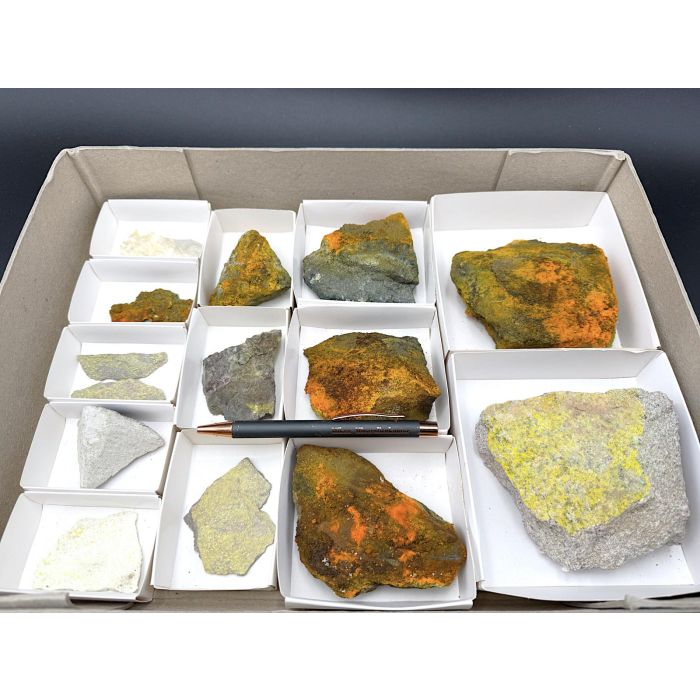
This flat with Pandoraite, Rakovanite, Pascoite, Metamunirite and Phurcalite crystals from the Pandora Mine in Utah, USA represents an impressive assemblage of secondary uranium and vanadium minerals from a classic Colorado Plateau deposit. The specimens display striking yellow to intense orange mineralization, often occurring as coatings or fine grained aggregates on the rock surfaces.
Some of the minerals form fine crystals and crusts that appear in various shades from bright yellow to vivid orange. A particularly notable feature is the strong fluorescence of many of these uranium minerals under both shortwave and longwave UV light, causing the specimens to glow intensely. The material illustrates several typical expressions of these rare secondary minerals from the Pandora Mine.
Geology & Origin
The Pandora Mine in the Paradox Basin of Utah is a well known locality for uranium and vanadium minerals hosted in sandstones of the Colorado Plateau. Mineralization formed when circulating fluids deposited uranium and vanadium within porous sandstone layers. Subsequent oxidation and weathering processes produced numerous secondary minerals including Pandoraite, Rakovanite, Pascoite, Metamunirite and Phurcalite. These minerals commonly occur as colorful coatings or crystal growths on the rock surfaces and are known for their strong UV response.