
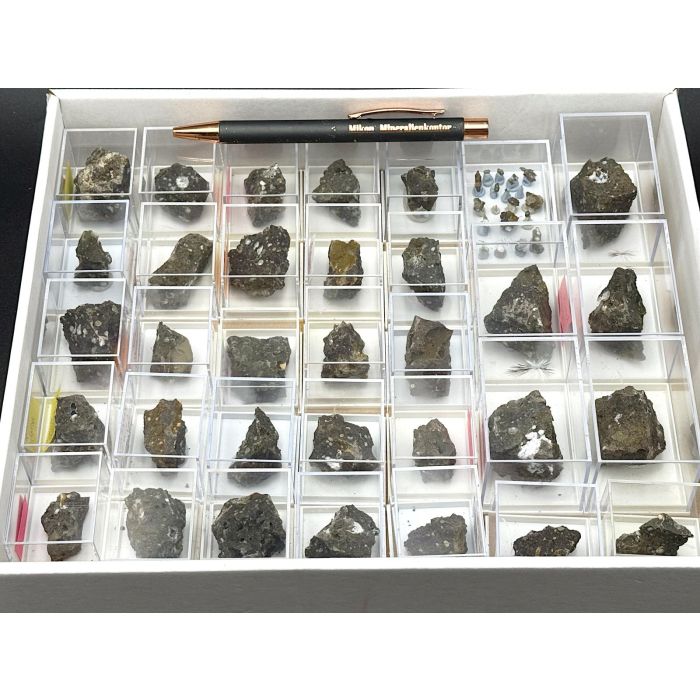
This half size flat contains a characteristic collection of zeolite bearing basalt specimens from the Horseshoe Dam area in Arizona. The dark, partly vesicular basalt matrix displays numerous cavities and amygdales in which light to white crystal formations have developed.
Crystals are clearly visible on many pieces. Herschellite and Phillipsite typically occur as fine, lustrous crystal coatings, small prismatic or tabular crystals, and dense light colored aggregates lining the vesicles. The contrast between the dark volcanic matrix and the bright zeolite crystals gives the collection a classic and visually appealing appearance. The flat shown corresponds exactly to the offered collection.
Geology & Origin
The Horseshoe Dam area in Arizona is known for zeolite rich basalts occurring in volcanic rocks of the region. The zeolites formed secondarily within gas cavities and vesicles of the basaltic lava through hydrothermal processes.
Herschellite and Phillipsite belong to the zeolite group and develop through the alteration of volcanic glass components under the influence of mineral rich fluids. This locality provides typical parageneses of this mineral group and is appreciated by collectors for classic zeolite occurrences from the United States.