
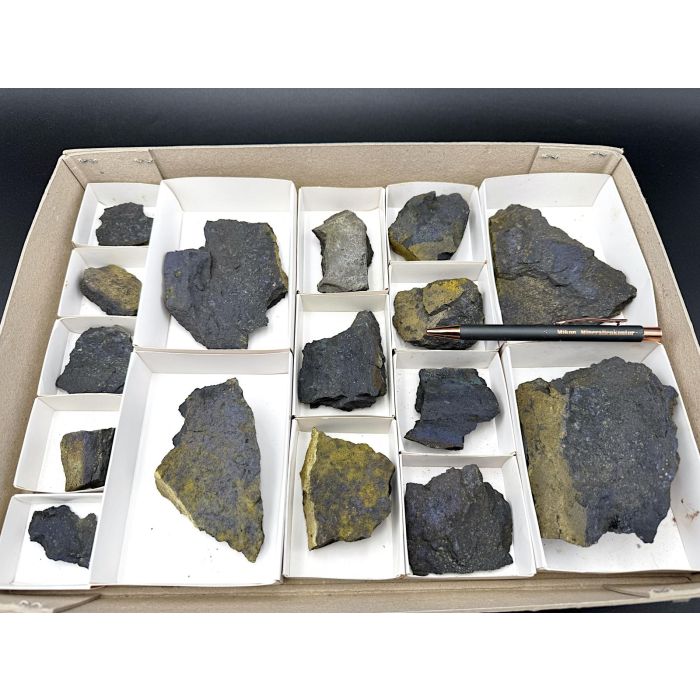
This flat with Corvusite, Coffinite and Montroseite from the Pandora Mine in Utah, USA represents a typical association of uranium and vanadium minerals from this classic locality of the Colorado Plateau. The specimens consist mainly of dark, massive to finely structured mineral aggregates with dull to slightly metallic surfaces. Deep dark blue to black areas characteristic of Corvusite occur together with similarly dark Montroseite mineralization.
The individual pieces show different textures of the mineralization, ranging from compact aggregates to fine grained mineral rich zones with yellowish to brown weathering coatings. These color contrasts commonly result from secondary oxidation processes affecting uranium and vanadium bearing minerals. The material illustrates the typical ore paragenesis of this well known uranium vanadium deposit.
Geology & Origin
The Pandora Mine in the Paradox Basin of Utah is a classic locality for uranium and vanadium minerals hosted in the sandstones of the Colorado Plateau. Mineralization formed when mineral rich fluids circulated through porous sandstone layers and deposited uranium and vanadium. Minerals such as Corvusite, Coffinite and Montroseite developed as fine grained to massive ore aggregates. Deposits of this type were extensively mined during the mid 20th century for uranium and vanadium production.