
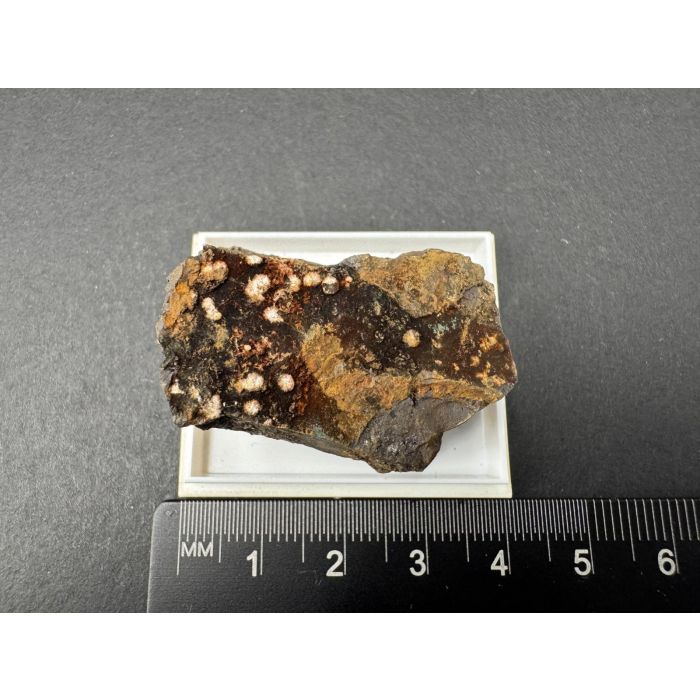
Churchite-(Y) crystals from Auerbach, Upper Palatinate, Germany – miniature specimen as unique piece
This miniature specimen shows Churchite-(Y) crystals from Germany in a characteristic formation on a dark iron rich matrix. The crystals appear as small rounded to rosette like aggregates with a light whitish color clearly contrasting with the brown to black host rock.
The individual crystal aggregates are well visible and evenly distributed across the surface creating an attractive visual contrast. The matte to slightly silky surface of the Churchite-(Y) crystals gives the specimen an interesting texture. Despite the small size the crystals are clearly recognizable and provide a visually appealing presence on the matrix.
Geology & Origin
Churchite-(Y) is a rare yttrium phosphate belonging to the group of hydrated phosphates. It typically forms in the oxidation zone of mineral deposits often as a secondary mineral resulting from the alteration of yttrium bearing primary minerals.
The locality Auerbach in the Upper Palatinate is known for complex mineral assemblages within iron and manganese deposits. The geochemical conditions there favor the formation of rare secondary phosphates such as Churchite-(Y) which commonly develop as small but well defined crystal aggregates on the matrix.